Forest School, led properly
“A child who is given time in a wood does not need to be taught to notice. They need to be left alone long enough to start.”
I’m a Level 3 qualified Forest School Leader working across England. I plan and lead full Forest School programmes for schools, nurseries and community groups — and I’m trained to run one-to-one sessions for children with SEND, where a group setting isn’t the right fit.
-
L3
Level 3 Certificate in Leading Forest School The qualification required to plan and lead your own Forest School programme — not just assist on one.
-
C
Trained with Cambium Sustainable One of the UK’s established Forest School training providers.
-
1:1
Trained for one-to-one SEND work For children who need the woodland without the group around them.
Insurance, DBS, first aid and full risk assessments are in place. Happy to share documentation before we start.
Three ways I work
Forest School programmes
Full programmes for schools, nurseries and community groups — planned, led and reviewed by me, run as a block across a term or longer. Group size depends on the site, the age of the children and the staff out with us.
Includes site assessment, session plans, observations and an end-of-block review you can keep.
Individual sessions
I’m trained to work one-to-one with children with SEND, and with children for whom the group is the barrier rather than the point — anxious, overwhelmed, school-avoidant, or simply needing their own pace.
Same Forest School principles, no group to keep up with. Often commissioned by schools for a named pupil, or arranged directly by families.
Natural pigment sessions
Standalone workshops, or a strand woven through a longer programme: making colour from the earth, charcoal and plants of the site you’re standing on.
Works for children and adults, and sits neatly alongside art, science and outdoor learning curricula.
What a session actually looks like
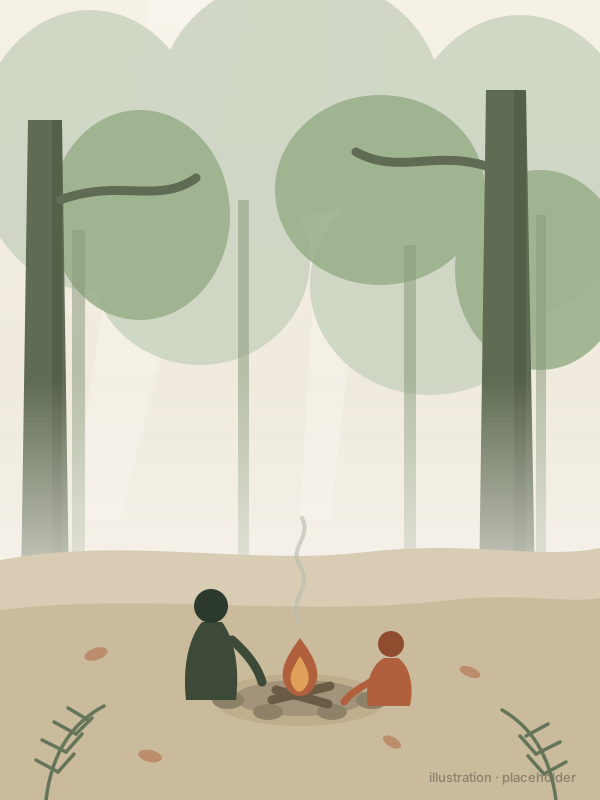
We use the same patch of woodland each time. Nothing is rushed. Early sessions are usually spent doing very little — walking the boundary, learning where the light comes through, finding a spot that feels like theirs.
From there the children lead. That might mean fire-lighting and cooking, tool work with a knife or bow saw, shelter building, tracking, or sitting still and drawing what they can hear. My job is to hold the space safely and follow what they’re curious about — not to march them through an activity list.
Forest School is defined by repetition. A single visit is a nice day out; a block across a term is where the confidence, the risk-judgement and the language actually grow. That’s why I ask for a block of at least six sessions — whether it’s a class of fifteen or one child.
Natural pigments
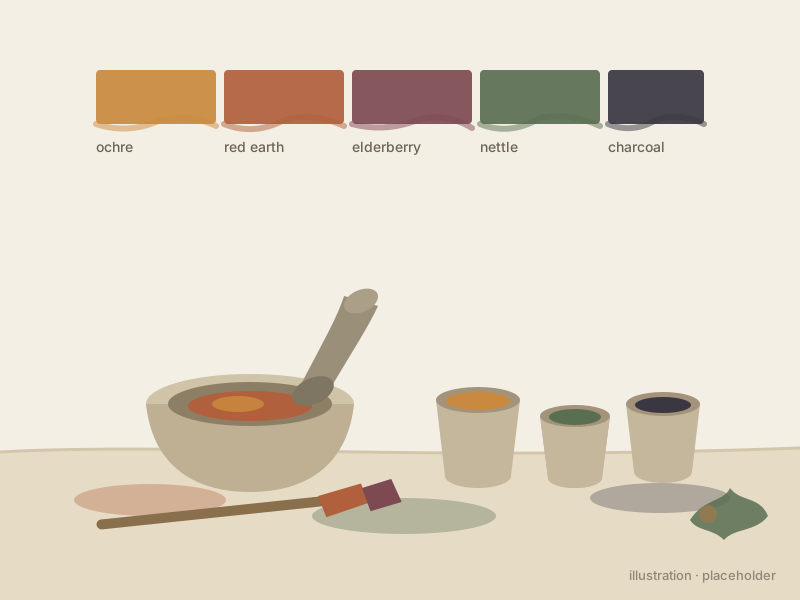
This is the part of my practice I’ve gone deepest into. We make our colour from the site itself — clay and ochre from the ground, charcoal from the fire we lit, ink from oak galls, dye from elderberry, nettle and onion skin.
Grinding your own pigment is slow, and that’s the point. A child who has spent an hour making one small pot of brown treats that brown differently. It teaches geology, chemistry and plant identification without any of those words being used.
I bring the mortar, muller and binders; the colour comes from wherever we are, which means no two sites produce the same palette. It also makes the work genuinely place-specific — a school ends up with a paint chart of its own grounds.
Across England
I travel to sites across England. Sessions run in woodland, on school grounds, on commons and in private woods — anywhere with tree cover, a safe boundary and permission to light a small fire.
If you have a site in mind, I’ll assess it before we start. If you don’t, I can usually help you find one nearby. Travel beyond a reasonable radius is quoted per booking, so tell me roughly where you are when you get in touch.
Before you get in touch
How long is a session?
Usually two to three hours. Shorter and the slow part never happens; much longer and most children are done.
How many sessions do we need?
Forest School is defined by being long-term, so I ask for a block of at least six. A term-long run of ten to twelve is where I see the biggest change.
How big can a group be?
It depends on the site, the age of the children and how many of your staff are out with us. I’ll give you a firm number after the site assessment rather than guessing now.
Do you work with children with SEND?
Yes — both within groups and one-to-one, which I’m specifically trained for. Tell me what your child or pupil needs when you enquire and I’ll be straight with you about whether I’m the right fit.
What if it rains?
We go out. Sessions only stop for high winds, which are a genuine hazard under trees. I’ll advise on clothing before the first session.
What does it cost?
It depends on the site, the travel, the group size and the length of the block. Get in touch with your location and rough dates and I’ll send a straight answer.
“If you walk slowly enough, the earth begins to speak.”
Programmes are booked in blocks and I only take a small number at a time.